Hypocrites In The Church

Imagine if you were watching the Family Feud game show and the host said, “Name a reason people stop going to church.”  The number one answer on the board would likely be “Hypocrisy.”  We hear this frequently.  “I stopped going to church,” or “I never go to church,” or “I changed my church,” or even, “I no longer believe in God because of all the hypocrites.”

The fatal flaw in such reasoning is that there is nowhere in the world to go where there are no hypocrites.  It has often been said that if you discover the “perfect” church, don’t go in.  If you go in, it will then contain a hypocrite, and you will have ruined it.  We are all hypocrites.  Some of us may try to deny it, but the fact remains that we are all imperfect.

Should you decide to eschew “organized religion” and worship God independently, all you will accomplish is to organize your own, private religion with one member that just happens to be a hypocrite.  So, that doesn’t solve the problem.  Your “private church” will still be full of hypocrites.

Hundreds of years ago, reformers tried to “fix” hypocrisy in the Church.   Consequently, all of the churches started since the Reformation have been started by imperfect human beings who happen to have all been hypocrites.  The Church was originally formed by Jesus Christ.  Jesus is the only man who ever lived that was a perfect, non-hypocrite.  Consequently, when choosing a church, why not at least choose the one that was formed by a perfect, non-hypocrite?  Why should an imperfect hypocrite believe that he or she can re-form what was already formed by the perfect, non-hypocrite, Jesus Christ?

Hypocrites in the Church do not negate the truth of the Church anymore than out-of-shape people in a gym negate the benefits of exercise.  Instead of trying to run away from hypocrites we need to be running towards Christ and embracing the benefits of His Church.  Otherwise, we’re just running from hypocrisy into the arms of more hypocrisy.

“What Would Jesus Do?” Try Asking, “What Did Jesus Do?”

“What would Jesus do?”

The answer to that question often depends on who you ask.  It’s a question that fits nicely into the relativistic mind of our age.  It allows each of us to thoughtfully rub our chins, look up at the sky and say, “Well, I believe Jesus would…”  So, the question is really just Jiminy Cricket’s “follow your conscience” line wearing a Christian mask.  It is relativism presented as religion.  Whatever answer you come up with is as good as anyone else’s answer as long as we are all “sincere.”

Often, the honest answer to the question “What would Jesus do?” is “I really don’t know.”  His disciples lived with him for three years and Jesus constantly kept them surprised and guessing.  Why are we so convinced that we have Jesus pegged?  For example, it astounds me when celebrities claim to know what Jesus would or would not approve of, as if being a famous celebrity makes one an authority on the mind of Christ.

When we ask, “What would Jesus do?” we can only think and act hypothetically.  We can only speculate and take our best guess.  Maybe we’re helping, maybe we’re doing harm.  What if we decide to do the exact opposite of what Jesus would actually do?  Our world faces daily situations for which there are no explicit instructions in the Bible.  Dealing in general, biblical principles does not always provide enough specifics.  Asking what Jesus would do often doesn’t help much.

Perhaps a more helpful question is, “What did Jesus do?”  There are documented answers to that question.  In terms of what our world faces today, an important answer is, “Jesus established an authoritative, teaching Church to guide us and to spiritually feed us.”  In the midst of all the confusion over what Jesus would do, we have a Church to inform us of what we as followers of Jesus in this present day are to do and what we are not to do.

I sometimes hear people defend immorality by stating that the Bible is silent or ambiguous about certain modern day issues.  Of course it is!  Jesus never told his disciples to write a book to instruct us on every possible, future, moral issue.  Jesus established a Church (only one Church) with the authority to provide us with those instructions on faith and morals.  Jesus did not establish multiple church denominations to speculate and argue about what He might or might not do.  Men established those churches (some very recently).

God is not the author of confusion.  Jesus did not leave us with a Bible, the Holy Spirit and hypothetical questions about what He would do.  He left us with His Church, guided by the Holy Spirit, to lead us into all truth.  Does this mean we always have every answer to every question?  No.  Does it mean we put it to a vote when we are confused about what Jesus would do?  No (Christianity is not a democracy).  It means that by following His Church we are following Jesus.  We are to strive for obedience to the faith, not speculation.

It comes down to trust (i.e. faith).  Either we trust with all our heart that Jesus knew what He was doing when He established the Church (trust what He did), or we try to constantly change the Church to conform to our speculations about what Jesus would do (lean on our own understanding and feelings).

Fear

It is good when fear motivates us to jump away from a coiling snake or to wear our seat belts.  These are examples of God-given reflexes and reason.  It is not good when fear motivates us to sin.  Much sin is rooted in fear.  It stems from a lack of trust in God.  Our fears are exploited by the powers of darkness and used to tempt us away from love and toward sin.  I am reminded of the line from the classic movie Poltergeist, “It knows what scares you.”

Virtually any sin we can think of can be traced back to some fear.  Virtually any fear can result in some type of sin.

We Americans like to talk about rights and justice.  Seldom do we get to the heart of the matter.  When we violate God’s moral or natural laws we are usually motivated by fears which fuel our lack of trust in God.  We also like to use the word “love,” but we fail to understand the word.  We think love is simply another pleasant emotion instead of a courageous, selfless act of the will.

We are taught that courage is a virtue and that fear is a weakness.  So, instead of admitting that we have sinned because we are afraid, we mask our sins under the cover of “rights” and “justice.”  This makes us seem courageous, but often it is just like Adam and Eve hiding from God and wearing “fig leaves” to cover their shame.  So, the first step is to recognize sin for what it is and choose God’s love instead (even when it’s really, really hard).  Otherwise we remain stuck in the circular rationalization of our sins.

Next, we must ask ourselves what we are afraid of.  When we acknowledge our fears we are better able to see how they pave the way for sin.  Is our sin rooted in a fear of what we might miss out on (some pleasure, perhaps)?  Is it rooted in a fear of increased responsibility?  Is it a financial fear?  Is it a health related fear?  Whatever the fear, there is likely a lack of trust in God that accompanies it.  So, we choose our way instead of God’s way, and we sin.  We violate God’s moral or natural law.  We choose fear over love.

“God has not given us the spirit of fear; but of power, and of love, and of a sound mind.” (2Tim 1:7)  “There is no fear in love; but perfect love castes out fear; because fear has torment.  He that fears has not been made perfect in love.” (1John 4:18)

What are your fears?  You may have to dig deep to find some of them.  Can you choose God’s ways in the face of them?  Will you let perfect love cast them out?  Or will you remain crouched behind your right to do things your way?

Love

People use the word “love” in various ways.  Usually, it has something to do with how they feel about someone or something.  “I love ice cream,” or “I love walks on the beach,” or “I love my boyfriend,” etc.  Love has been so thoroughly linked to feeling, emotion and romance that people tend to perceive it as being beyond their control.  “Falling” in love is like slipping on a banana peel.  It just “happens” to us and there is nothing we can do about it.

There is a higher form of love.  Although it may involve experiencing certain emotions, it is not, in and of itself, an emotion.  This higher form of love is a choice.  It is an act of the will.  It does not “just happen.”  It must be consciously chosen.  It must be chosen even when the feelings connected with it are unpleasant or undesirable.  Feelings cannot guide this kind of love.  It transcends feelings.

To really love someone is to will the highest good for that person regardless of one’s feelings toward that person.  This is why Jesus commands us to love our enemies.  He is calling us to the higher form of love that is not guided by emotion.  What good is it to only love your friends?  Even the worst people can do that because they are using the lowest form of “love” which is based on feelings rather than choice.  Anyone can fall in and out of love while riding the waves of emotion.  Higher love (godly love) demands that we make a choice and stick to it despite our feelings.

I think it was G.K. Chesterton who said, “There is a reason Jesus told us to love our neighbors and also to love our enemies.  It is because they tend to be one in the same.”  When pressed for an answer to the question, “Which is the greatest commandment?” Jesus answered, “Love the Lord your God with all your heart, mind, soul and strength, and love your neighbor as yourself.”  These two commandments sum up all the rest of God’s laws.  Following this standard cannot be accomplished through the guidance of emotion.  Love is a choice, whether it is a choice to love God or to love our neighbors.  Feelings are secondary and must not derail true love.  Jesus said, “Love your enemies,” not “Like your enemies.”

To love another is to will the highest possible good for that person.  God is the highest possible good.  Therefore, to really love someone is to desire that they become intimately connected to and redeemed by God, the highest possible good.  Emotions are not the bottom line.  Desiring that people find their way to the highest possible good is the bottom line.  That is godly love.

Think about a person that you find the most emotionally difficult to love.  When you decide that you want the highest possible good for that person despite your feelings towards that person, then you are on the path of higher love.  When your will takes over for your emotions, then your words and actions can reflect authentic, godly love.  Look at a crucifix and you will see the highest good.  God is love.  The choice is ours.

Faith: “Personal” Or “Private?”

The words “personal” and “private” may cause confusion at times.  Not everything that is personal needs to be private, although some things are.  In fact, some personal things are actually supposed to be quite public.

For example, a marriage is a very personal, intimate relationship, and spouses keep certain aspects of the relationship very private.  The marriage relationship itself, however, is quit public.  Even so called “private weddings” still require public licenses and witnesses to be valid.  Christian spouses are supposed to be public witnesses to the relationship between Christ and his Church.  So, a very personal relationship is also meant to be a very public one.

One’s annual income is generally considered to be personal information that is also private.  It comes across as rude to inquire about someone’s income.  When asked, “How much do you make?” one might respond, “I’m sorry, that’s personal.”  What is really meant, however, is, “That’s private.”  One’s name is also “personal” information, but we tend to freely divulge it when asked, so it becomes both personal and public.

Privatized religion is a strange phenomenon, especially where Christianity is concerned.  It makes complete sense that one’s religious beliefs are personal, for if one’s faith in God does not impact one’s person, there is little point to it.  This, I believe, is at the heart of why many try to make a distinction between “religion” and “relationship.”  Religion is often branded as impersonal while a relationship is assumed to be personal.  The reality, however, is that religion can and must be quite personal.  The whole point of the Christian religion is to be personally transformed by God.  Yet, the Christian religion is not meant to be “private.”

Christianity is meant to be lived in full view of the public.  The Christian is to be a “city on a hill” not a “light hidden under a bushel.”  Certainly, Christianity is personal.  It should transform a person.  But, if one’s Christian faith is always private, that is a problem.  At some point, many Christians bought into the idea that being open about one’s faith is taboo.  Somehow, the very public proclamation of the Gospel became a “private” matter not to be broached in public.  “Go and spread the Gospel” became “Don’t offend anyone or draw any attention.”  This happened despite the fact that Christians were told from the beginning that their faith would offend many people and that it was supposed to draw attention from the world.  Political correctness has overruled the Great Commission for many Christians.

Now, I can certainly understand why some Christians in certain times and places might keep their faith somewhat private, at least from the powers that be.  For two thousand years many Christians have had to face death and torture for being Christian.  Nevertheless, many of them gave (and still give) their lives rather than recant their belief.  That which is deeply personal need not be private.

I have heard people say things such as, “I don’t go to any church and I don’t want to talk about religion.  My God and I do just fine together.”  My reaction is, “If your faith is such a wonderful thing, why horde it for yourself?  Why keep all of that great stuff hidden from everyone?  That seems like a selfish thing to do, especially if you claim to be a Christian.  Why not tell people about your wonderful God?  Why not proclaim what you believe, why you believe it and what difference it makes to you and to the world?  What are you so afraid of?”

Finally, the Christian faith is about community.  In a community, people give, share and exchange things and ideas.  Christianity is not about isolation.  The idea is to have a relationship with Christ and then share the benefits of that relationship with others.  Christianity is not a private “security blanket” to be clung to like the Peanuts character Linus.  Christianity is a treasure to be freely distributed to others in word and in action.

So, by all means, have a deeply personal, Christian faith.  Just don’t keep it private.  Share the joy.

Speak And Hear In The Flesh

First, imagine that you live in the time of Jesus.  Next, imagine that you have come to believe that Jesus is who he claims to be, namely, God.  Then, you begin to ponder the state of your soul.  You realize that in many ways you have sinned against God and the humanity God created.  It suddenly occurs to you that the very God you have sinned against is in town, right now, in the flesh.  What would you do?

Hopefully, you would go into town and find Jesus.  You would seize the opportunity that awaits you.  It might require some effort on your part, however.  You would probably need to make the journey on foot.  When you finally arrived in town, you would need to figure out where to find Jesus.  Is he walking the streets?  Is he staying in someone’s home?  Is he preaching at the Temple or outside of town?  After some searching and polling of the locals you finally figure out where he is.

Once you get to his location you see that he is surrounded by many obstacles.  There are people all around him.  You must find a way to get through.  After squeezing and prying your way through the crowd you at last find yourself face to face with Jesus.  He looks at you as if he has been expecting you.  He seems to know the effort it took for you to be there before him.  Then he waits.

Jesus knows that “out of the mouth flows the intents of the heart,” so he waits.  He waits for you to open your mouth.  He already knows what is in your heart, but he wants you to say it.  Jesus, the “Word made flesh” wants you to use your fleshy mouth to form the words of your heart and convey them to his ears of flesh.  He wants to hear you say, in your own words, “Lord, be merciful to me, a sinner!”

As you speak the words, you sense that every syllable, every inhale and exhale of breath is releasing something you have been holding in.  Even your body language, the nonverbal expression of your message, reveals the depth of your heart as it pours out to Jesus, seeking new life and restoration.  At last, you have come to Jesus with all of your physical and spiritual being.

Finally, you raise your fleshy eyes to his.  Your ears of flesh hear his mouth of flesh declare with God’s authority, “Be at peace.  Your sins are forgiven!”

Transport to present day.  We still live in the time of Jesus.  Jesus said, “I am with you always.”  He still wants us to share our hearts with him through fleshy means.  So, he gave his own authority to fleshy men.  “As the Father sent me, so I send you.  Whose sins you forgive are forgiven.  Whose sins you retain are retained.”  We still get to speak the words and hear his forgiveness.  And it still requires a degree of physical effort.  We have to find a time and a place to meet with a priest who stands in for Christ as we confess to God.  We still have to push through the obstacles.  We still need to feel the humility that can only come from speaking out loud to another.

Of course, we can pray to God anywhere anytime.  God is everywhere.  But, Jesus wants our relationship with him to be more than a spiritual, “telepathic” sort of communication on a golf course, at home or even in a church.  Jesus became a human being.  He wants us to be in full relationship with him, body and spirit.  When we hurt someone, we should apologize to them in person whenever possible.  Jesus makes it possible through the Sacrament of Confession.  Jesus is still in town.  Go meet with him and tell him what’s on your heart, in the flesh.  That’s how he made you.  That’s how he wants to meet with you.

Relax The Moral Standards?

Why does the Catholic Church refuse to “relax” certain moral standards even when a high percentage of Catholics desire such a move?  It’s because the job of the Church is not to produce “nice,” spiritually mediocre people who “get along” with everybody.  The job of the Church is to produce saints, people of radical holiness.  Lowering moral standards would mute the call to sanctity.

At the same time, the Church has a most lenient penitential system.  We all fall short of Jesus’ standard of perfection and require God’s mercy.  The other job of the Church is to be the vehicle of God’s love and mercy when we fall.  God’s loving mercy does not lower moral standards.  Mercy provides help and support in shooting for those standards.

Catholics (indeed, all Christians) are called to radical holiness.  We are all called to sainthood.  Lowering the bar won’t cut it.  Instead, seek to meet the bar.


(Paraphrase of a commentary by Fr. Robert Barron)

Why The Thief On The Cross Does Not Disprove Purgatory

Recently, I read a post by Stephen Ray regarding the misuse of 2Cor 5:6-8.  Many people believe the passage proves that there is no such thing as Purgatory since “to be absent from the body is to be present with the Lord.”  Mr. Ray explains why that is a misreading of the text.  Some of the comments to the post also pointed to the thief on the cross as a reason to reject the idea of Purgatory since Jesus told the thief, “This day you will be with me in Paradise.”  “See,” they will say, “there is no ‘lobby’ or ‘front porch’ or ‘mud room’ to Heaven.  One either goes straight to Heaven or straight to Hell.”

The experience of the thief on the cross does not disprove Purgatory.  First of all, Catholicism does not teach that everyone must go through Purgatory, only that there is a Purgatory for those who need that purification.  Martyrs, for example, having suffered for the faith in unspeakable ways, likely do not need the purging experience of Purgatory to release them from lingering attachments to this life.

Secondly, the thief was already suffering on his cross and such suffering can be part of (or the whole extent of) the purging process.  We do not know exactly when the thief believed in Christ, but Jesus knew.  It may have been long before he was crucified next to Jesus.  The thief’s cross may have perfected him since we are told by Christ to suffer our own crosses and lay aside all other attachments to follow Him.  The thief knew he was getting what he deserved.  He was willingly making reparations for his sins.

Recall there was another thief being crucified next to Christ, but he did not believe in Christ.  He mocked Christ.  He did not take up his cross to follow Christ.  He took no ownership of his sins or the consequences of them.  His suffering was more like Hell than Purgatory.  No Paradise ahead.

Thirdly, Christ was right there, present with the thief, “on the front porch of Heaven” if you will.  That’s why Christ, in all the burning fire of His love, fully present with the thief could say, “Today you will be with me in Paradise.”  It is a great picture of Purgatory.  The believer, in a state of suffering complete separation from worldly attachments, expresses his desire to be with the Lord who welcomes him off of the “front porch” and into His house.

When Christ ascended to Heaven, the so called “front porch” went with Him.  Rather than being nailed to a literal cross, the “fire” of Purgatory now does the purging for us.  In order to enter Heaven, every hint of attachment to things other than Christ must be eliminated (perfection).  Whatever detachment does not take place in this world is resolved in the fire of Christ’s purifying love.  Purgatory is not a “location” but a “state of being” that prepares the believer to enter Heaven completely pure and holy.

Rather than disproving Purgatory, the thief on the cross is a great image of Purgatory.  Many of us will need to spend time “hanging on the thief’s cross” so to speak, before we are ready to enter Heaven.  It’s not that our suffering replaces the sacrifice of Christ.  It’s that we need to completely let go of the rope we still have tied to things in this life.  That can require some pretty serious rope burn before we completely release our grip.  Hence, we pray for the souls in Purgatory, to help them loosen their grip.

Something Amazing!

I sat down next to a guy at lunch the other day and noticed that he seemed to be deep in thought about something very serious.  He was just sitting there, staring at his coffee and stirring it with a stick.  Finally, I decided to strike up a conversation with him.

“They make pretty good coffee here, don’t they?”

He just looked at me as if he heard my words but didn’t understand the meaning.  Then he blinked a few times and said, “Yeah, the coffee is great here.”

“Good,” I said with a smile, “The way you were looking at yours I was afraid it might be poison.”

He chuckled a little.  Then, with a small grin, he turned to look at me and asked, “Do you want to hear something amazing?”

“Sure.”

“I have a friend who was murdered a while back.”

“That’s horrible!  I’m so sorry for your loss.”

“Thanks.  The thing is, before he was killed I did something stupid.  I pretty much ripped his heart out and stomped on it.  It was like I knew what I was saying was wrong but it kept coming out of my mouth anyway.  You know what I mean?  I didn’t have a chance to apologize before he was killed.”

“Man, that really sucks,” I said, wondering where the amazing part was.

After a long, awkward pause I said, “Well, I’m sure your friend would have forgiven you if only you had been given the chance to apologize.”

“Well, that’s what’s so amazing.  I may just get the chance after all.”

“What do you mean?”

The guy looked around the room and became sort of giddy.  “I’ve been dying to tell people this.  I just can’t keep it to myself anymore.  At first it scared me to death, but now I just have to share it.  My friend is alive!”

“Uh, you mean he wasn’t killed after all?”

“Oh, no, he was brutally murdered.  He was even buried.  But now he’s alive again!  I saw him!  Lots of people have seen him!  That’s the amazing part!”

“Um, really?”

“Yeah, and that’s not all.  The day he was killed, lots of people who were dead were seen alive again all over town!”

“Hmm…I did not know that,” I said, trying to be polite.  “That does sound amazing.  Well, I have to get back to work now.  It was nice talking to you…uh…”

“Peter,” he said, finally introducing himself.

“Oh, I’m Thomas.  Nice meeting you, Peter.  Have a good one.”

Christianity has what Fr. Robert Barron calls a grab-you-by-the-lapels quality.  Jesus was brutally murdered and then rose from the dead.  Hundreds of witnesses saw him, talked to him and ate with him.  This was not some David Copperfield or Chris Angel magic illusion.  Without the resurrection, Jesus was just another nice guy or an inspiring teacher.  The apostle Paul said that if Jesus did not rise from the dead, then we are all still dead in our sins and our faith is in vain.  No other religion or philosophy compares to the message of Christianity.  It is a message the disciples were willing to die for because they knew it to be true.  Resurrection.

What if something amazing happened to you?  What if you caught a huge fish or won a big prize or became cured of cancer?  What if your favorite ball team won a championship?  Would you keep the news all to yourself?  Does the fact that Jesus actually rose from the dead compel you to spread that news to others in some way?  Does it amaze you?  Do you really believe?  Without the resurrection, all we have to tell is what anyone else could tell.  Without the resurrection, we’re all just wasting our time.  I say that as I grab you by the lapels.

Why It Was The Best Holy Week I Have Ever Experienced:

Monday:

In the evening we had the monthly meeting of our men’s group.  Although we had been meeting for a couple of years, there was a moving of the Spirit which prompted some men to witness to the power of God in their lives.  It felt as though the time had come for the group to move deeper into the Faith and to share it with others in new ways.  It was a refreshing and encouraging meeting.

Tuesday:

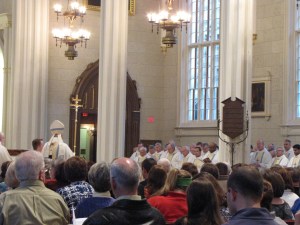
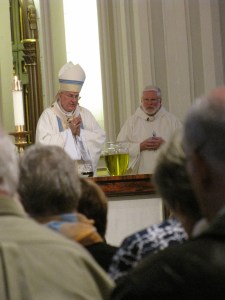
We went to the Chrism Mass at the cathedral and experienced the blessing of the holy oils.  The oils are distributed to parishes throughout the archdiocese for use in the sacramental life of the Church.  Each church has a special place to keep and display the holy oils.  Also, during the Mass, priests from around the diocese renewed their commitment to their vocation, and the congregation warmly acknowledged several new seminarians preparing for the priesthood.

As the liturgy engaged all five senses, I was reminded that, unlike the angels, God gave us physical bodies for a reason.  God came to us physically 2000 years ago, and he still does today in the Eucharist.  It was true worship.

IMG_3955 IMG_3963 IMG_3970

Thursday:

The foot washing Mass commemorated the humble and loving example that Jesus showed His disciples by lowering Himself to the place of a servant and washing their feet.  The priest knelt to wash the feet of twelve members of the congregation (one of which was my wife).  It was a moving display of God’s love for us, and the attitude Christians must have towards others.

Friday:

On Good Friday we gathered with soberness of heart while meditating on the depths to which Christ lowered Himself for our sake.  Each of us went forward to venerate the cross.  At the foot of the cross, we showed respect and gratitude for the price Jesus paid for our sins.  It is always a moving experience.

Saturday night Easter Vigil:

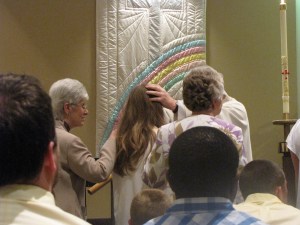
The Rite of Christian Initiation of Adults (RCIA) is approximately a nine month process in which people wishing to become Catholic Christians are catechized and brought into the Church community.  It is not a quick process, because the Church regards being Christian a very serious matter.  The Church also recognizes that conversion is not a one-time event, but a life-long process of growth, learning and discipleship.  Being Christian is about a relationship with Christ, and a relationship with Christ is fully realized and expressed within the context of knowing Christ’s Church.

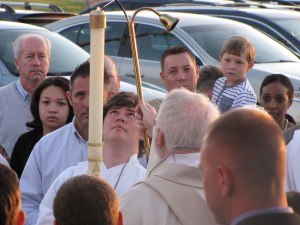
Those in RCIA finally enter full communion with the Church during the Easter Vigil.  It begins with the blessing and lighting of the Paschal candle outside the church at a small bonfire with everyone gathered around.  From there, we enter the church in a candlelight procession.  As the service progresses, the music becomes more celebratory and the lights become brighter.  The crucifix has been replaced by the image of the risen Lord.  We are ushering in Easter, the resurrection of the Lord!  Death is swallowed up in victory!

IMG_4079 IMG_4082 IMG_4089

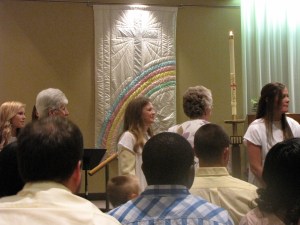
Catechumens (those who are not yet Christian) receive the Sacraments of Baptism, Confirmation and Holy Communion.  Candidates (those who are already Christian by virtue of their baptism in other denominations) receive the sacraments of Confirmation and Holy Communion.  We welcomed all of them with open arms as they entered into the fullness of the Christian Faith!  Our parish had about 15 of the over 400 hundred people entering the Church all over the diocese.

IMG_4134

One of the women that became Catholic this Easter spent more than the prescribed nine months preparing.  She had been through the customary RCIA period, but, at the end, was not ready to commit.  She still had much to process in her mind and in her heart.  She had always been a strong, faithful Christian.  She had a lifelong relationship with Christ and a strong foundation in scripture.  She took very seriously the implications of embracing Catholicism.

Nine months of study and discernment turned into four years.  No one pressured her to become Catholic.  They simply loved her, answered her questions as best they could, and gave her the space she needed.  The Holy Spirit did the rest, as only He can.

At the beginning of Lent, this woman (my wife, if you haven’t already guessed) approached me, pulled me aside and said, “I have something to tell you.  I’ve decided to enter the Church this Easter!”  My joy was increased in knowing that she had reached this decision in her own time, gently led by the Spirit of God who loves her.  My respect for her increased in knowing the courage it took for her to make this journey and that her decision had not been made lightly.  The years it took for her to step out in faith made it all the more inspiring to me and to many of those present Saturday night.  I am so grateful for how she has been led by the Spirit and embraced by the Church community.

Only she can tell her story.  I do know there are things she is still pondering and learning about, but that is what we all must do.  No one “knows it all.”  Conversion is a life-long process.  Christians are called to discipleship, which means we are to be constantly learning from the Master through His Church.  However, we can’t wait until we have every question answered before acting on faith.  St. Augustine said, “If you understand, then it is not God.”  We can’t intellectually grasp all the wonders of God.  We must take some things on faith.  That’s what makes it faith.  By faith, my wife had already accepted the salvation offered through her Lord, Jesus Christ.  Now, by faith, she has embraced the Church established by that same Lord, Jesus Christ.
IMG_4117 IMG_4126

My wife and I have always had a wonderful relationship.  Now our union has reached another level of intimacy with God and with each other.  The journey holds new possibilities as our path unfolds before us, God’s lamp lighting our way.

Easter Sunday:

My little nephew announced that he had decided to follow Jesus.  His journey has begun with the childlike faith Jesus calls all of us to have in Him.

Now you know why this has been the best Holy Week I have ever experienced!  Glory be to the Father, to the Son, and to the Holy Spirit, as it was in the beginning, now, and will be forever.  Amen!